A student can change a few words in a source, keep the same sentence shape, and still end up with a passage that is too close to the original to hand in. If you are trying to paraphrase without plagiarising, the reliable method is to understand the idea first, rewrite it in your own words and structure, cite the source, and then check that your wording is genuinely new. This is general guidance on using sources, offered without a mark and without a passage written for you to submit.
Read the passage until you can explain it without looking
The University of Hull Library (n.d.) advises that you aim for understanding, and that you should not have the source open in front of you while you write, because writing as you read makes accidental copying more likely. Johns Hopkins University Libraries (n.d.) make a similar first step: reread the original until you understand its full meaning, then set it aside before you write.
Close the book, article or tab once you think you have the point, and try to say the idea out loud or in a short note without looking back. If you cannot do that, you have probably not understood the passage yet and should read it again, including a little either side of the sentence so you do not miss a qualification (University of Hull Library, n.d.).
Write the idea in your own words and structure
Changing one or two words in the original is not enough, because your version should be distinct from the source in both wording and sentence shape, while still carrying the same meaning (University of Hull Library, n.d.). Johns Hopkins University Libraries (n.d.) likewise tell you to set the original aside and write the idea in a new form, then check later that the essential information is still there.
A short, made-up sentence can show the difference, and it is only a teaching example, not a real study. Swapping a few synonyms in "students who sleep fewer than six hours before an exam tend to recall fewer details from overnight revision," while keeping the same order and numbers, is still too close. A safer version recasts the point: "Last-minute revision followed by a short night of sleep can leave students with weaker recall of what they have just studied."
The University of Hull Library (n.d.) also lists useful tactics once you are working from notes, including changing the order of the information, using substitute words, and dropping details you do not need for your point. Those moves help only after you have understood the idea.
Compare your version with the source and add a citation
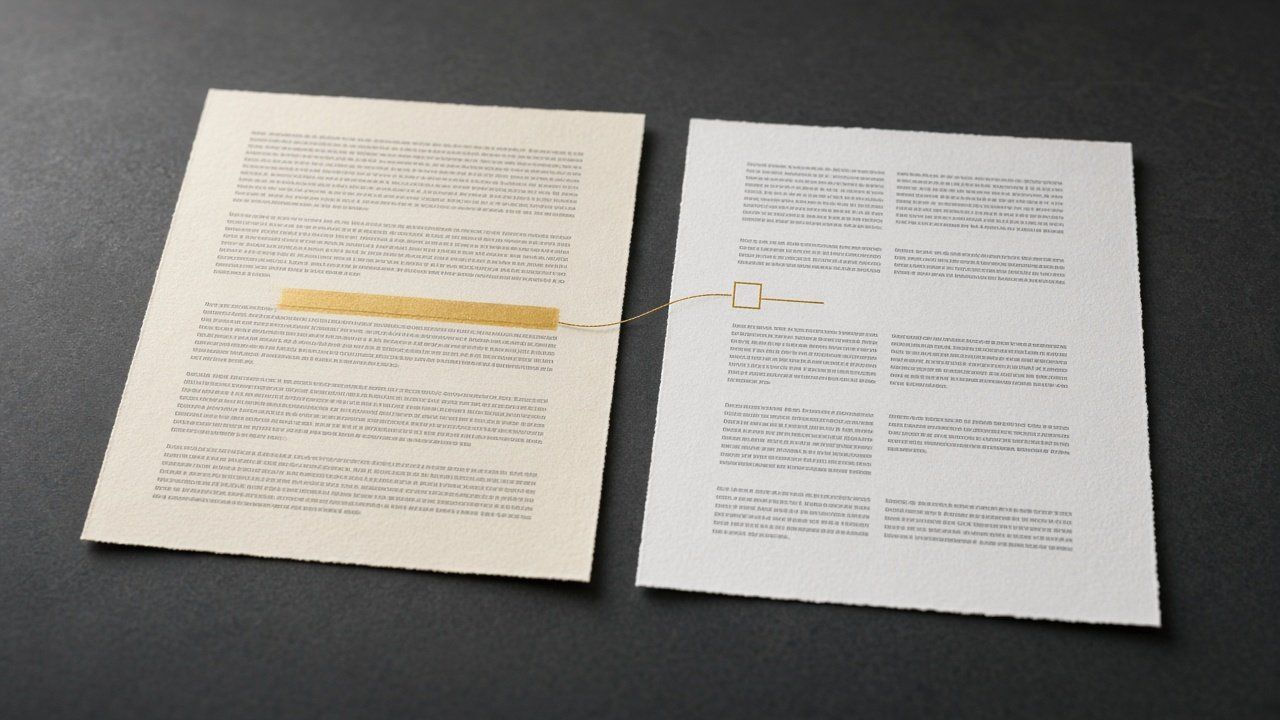
Once you have a draft sentence, put the original beside it and look for phrases, numbers or sentence patterns that have survived almost unchanged, because a paraphrase that is still too close should be rewritten or, if a distinctive phrase has to stay, placed in quotation marks (Johns Hopkins University Libraries, n.d.). You should also check that you have not accidentally altered the author's meaning, which sometimes means reading a little further in the source (University of Hull Library, n.d.).
A paraphrase still needs a citation, in the text and in the reference list, even when every word is yours, because the idea came from someone else (Johns Hopkins University Libraries, n.d.). Record the author, year and page while you work, and if two or three sentences in a row come from the same place, make that clear rather than citing only the last sentence.
Students sometimes hope a writing tool can rewrite the source for them, but the University of Hull Library (n.d.) warns that when you submit a piece of work you are declaring the words are your own unless they are clearly marked as quotations, and that using an AI tool to paraphrase someone else's words, or even your own writing, can be treated as false authorship.
Check the rest of the draft for leftover wording
A careful sentence can still sit in a paragraph that slips back into the source's wording two lines later, so it is worth reading the whole section against the notes and the original, looking for runs of distinctive phrasing you did not invent. If you are unsure whether a point counts as common knowledge in your field, cite it, because an extra reference is easier to defend than a missing one.
If you want a second look at a passage you have already rewritten, proofreading and editing and essay support can help you check whether the wording is sufficiently your own and whether the citations are in place, as advice on your own draft rather than a rewrite supplied for you to hand in. Once the idea is in your own words and the source is named, a useful last pass is to read the paragraph aloud and ask whether a marker could tell your voice from the source's without opening the book.
Frequently asked questions
Does changing the words with a thesaurus count as paraphrasing?
Swapping synonyms while leaving the original sentence structure in place is the pattern most guides treat as still too close to the source (University of Hull Library, n.d.; Johns Hopkins University Libraries, n.d.). You need a new wording and a new shape, plus a citation, before the sentence is ready to keep.
Do I have to cite a source if I have not quoted it?
You still need a citation whenever the idea, finding or argument comes from someone else's work, even if you have rewritten every word (Johns Hopkins University Libraries, n.d.). Quotation marks can come off after a true paraphrase, but the acknowledgement of the source still has to stay.
References
Johns Hopkins University Libraries. (n.d.). Paraphrasing and summarizing.
University of Hull Library. (n.d.). Academic integrity: Paraphrasing.